2026 How to Tell If Sintered Stone Slabs Are Heat Resistant?

Time:2026-09-23 Author:Henry
0%

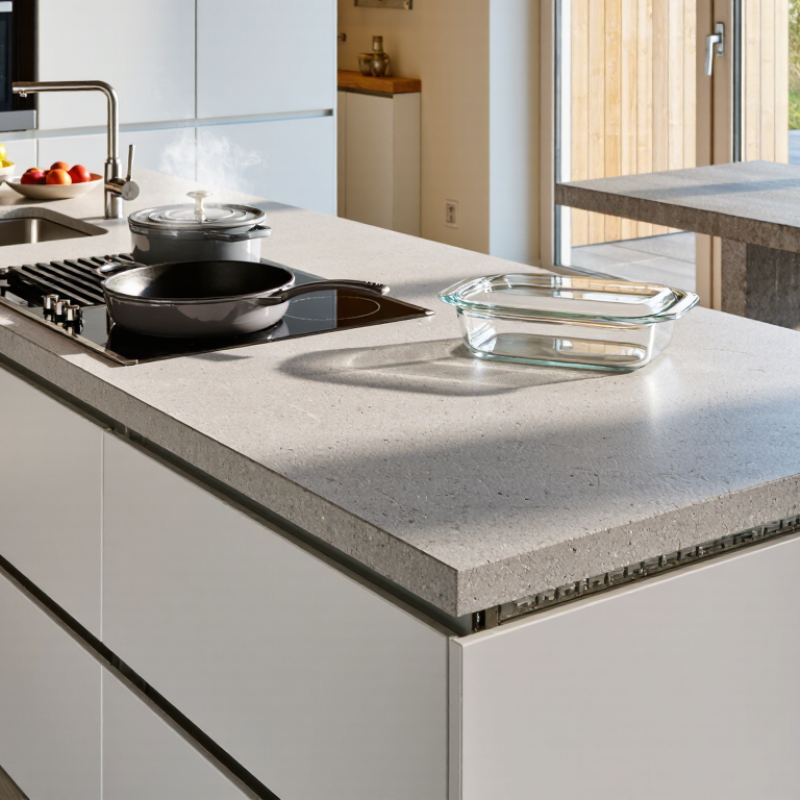
Are sintered stone slabs heat resistant? This question matters when a steaming pan meets a kitchen island, or sunlight warms a large outdoor countertop. In most cases, sintered stone offers excellent resistance to high temperatures. It is manufactured from selected minerals under intense pressure and heat. The finished surface is dense, nonporous, and stable during normal household use.

Materials engineer Dr. Elena Marín explains, “Heat resistance is a performance range, not a promise against every thermal shock.” That distinction is important. A slab may tolerate a hot baking dish, yet still suffer damage from sudden temperature changes, trapped moisture, or weak installation support. Heat can also affect adhesives, joints, edges, and the cabinet structure beneath the surface.

Real experience reveals the details. A cast-iron pan placed directly on the slab may leave no mark, but caution remains sensible. Use a heat pad near cutouts, unsupported overhangs, and delicate edge profiles. Check the manufacturer’s technical sheet for maximum service temperatures and testing conditions. Do not rely only on showroom demonstrations. They often show the surface, not the full installation.

The honest answer is qualified. Yes, sintered stone slabs are generally heat resistant for everyday cooking and many exterior applications. They are not indestructible. Poor fitting, thermal shock, or hidden structural weakness can change the result. Even experts should leave room for uncertainty. Product composition, thickness, color, reinforcement, and climate all matter. A careful inspection gives a more reliable answer than a simple sales claim.
2026 How to Tell If Sintered Stone Slabs Are Heat Resistant?

What Heat Resistance Means: Service Temperatures vs. 1,200°C Sintering

How to Tell If Sintered Stone Slabs Are Heat Resistant?

A 1,200°C rating can sound impressive, but it describes manufacturing, not everyday use. The European Commission’s JRC Ceramic Manufacturing BREF reports ceramic firing processes reaching approximately 1,200°C. During production, mineral particles densify inside a controlled kiln. A kitchen slab does not experience those conditions. It faces hot cookware, localized heating, cooling, and mechanical stress.

Service temperature means the heat a finished slab can tolerate without unacceptable damage. ISO 10545-9 evaluates thermal shock through ten heating and cooling cycles, commonly between about 15°C and 145°C. This test measures resistance to sudden temperature changes. It does not prove unlimited exposure to direct flames or a 1,200°C torch. ASTM C484 also addresses thermal shock performance, but test results still depend on the tested material and installation details.

In practical inspections, damage often begins near cutouts, unsupported corners, or poorly bonded seams. A pan may heat one small area while the surrounding surface stays cool. That temperature gradient matters. Ask for the declared maximum service temperature, test standard, test duration, and installation conditions. Check whether the result applies to the slab, adhesive, substrate, and joints together. Ratings are not always presented consistently. I would be cautious when a specification lists only “1,200°C heat resistance” without a service-temperature test. Even careful guidance can miss real kitchen variables.

How Composition Controls Thermal Expansion and Thermal-Shock Resistance

Sintered stone’s heat resistance begins with its mineral recipe, not its label. Dense bodies usually contain feldspar, silica, clays, and selected pigments. During firing, these minerals form crystalline phases and a glassy matrix. Their mismatch controls thermal expansion. ISO 10545-8 testing commonly places dense ceramic products near 4–8 × 10⁻⁶/K. Lower expansion generally means less movement during heating. It does not guarantee immunity.

Thermal shock depends on expansion speed and temperature gradients. ISO 10545-9 evaluates resistance through repeated heating and cooling cycles. A slab may survive a hot pan, yet crack beside a cold, wet cloth. Moisture can intensify the temperature drop. Dark surfaces near windows can also heat unevenly. That detail matters in real kitchens.

Composition is only half the evidence. Thickness, internal stress, cutouts, adhesive coverage, and cabinet movement also influence failure. The European standards framework, including EN 14411, emphasizes product classification and declared performance rather than broad marketing claims. Ask for the tested coefficient of thermal expansion and thermal-shock result. Check the test method, specimen thickness, and cycle conditions. A single “heat resistant” statement is weak evidence.

I would not rely on a household flame test. It creates uneven heating and proves little. The better question is simple: does the slab’s tested composition match the installation’s thermal stress? Even careful specifications can miss site conditions. That is where professional assessment remains necessary.

2026 How to Tell If Sintered Stone Slabs Are Heat Resistant?

How composition controls thermal expansion and thermal-shock resistance

Typical linear coefficients of thermal expansion are shown in 10⁻⁶/K. Lower expansion generally means less dimensional strain during rapid heating and cooling, improving thermal-shock resistance when the slab also has low porosity and adequate flexural strength. Values are representative material ranges; actual performance depends on mineral composition, thickness, internal defects, installation, and the test method.

Which Standards Apply? EN 14411, ISO 10545-9, and ASTM C484

2026 How to Tell If Sintered Stone Slabs Are Heat Resistant?

Heat resistance should be checked through documented testing, not surface appearance. A slab may look dense and flawless, yet thermal stress can still affect its edges or glaze. In practical inspections, place hot cookware on a test sample first. Watch for discoloration, cracking, surface dullness, or sudden popping sounds. Never assume a product is heatproof because it is marketed as sintered stone.

EN 14411 is important because it classifies ceramic tiles and sets requirements for groups, dimensions, and performance. However, it is not a simple “hot pan test.” Confirm whether the sintered slab falls within the declared product scope. ISO 10545-9 measures resistance to thermal shock through repeated temperature changes. This test helps reveal damage caused by rapid heating and cooling. ASTM C484 also evaluates thermal shock resistance for ceramic tile materials. Ask for the test method, specimen thickness, temperature range, and failure results.

Details matter. A laboratory result for a small tile may not represent a large slab with cutouts. Edges, sink openings, support gaps, and installation tension can change performance. I would request current test reports from an accredited laboratory and compare them with the actual slab specification. Reports without sample identification deserve caution. Real kitchens are less controlled. A hot tray, cold water, and a stressed corner can expose weaknesses that a clean laboratory sample misses. Still, these standards provide a credible technical starting point.

2026 How to Tell If Sintered Stone Slabs Are Heat Resistant? — Which Standards Apply? EN 14411, ISO 10545-9, and ASTM C484
Standard Primary Role What It Evaluates Typical Test Principle Result / Acceptance Basis What It Does Not Prove Practical Use for Sintered Stone Slabs
EN 14411 Product standard for ceramic tiles and slabs Classification and requirements for ceramic tiles, including dimensional characteristics, surface quality, physical properties, chemical resistance, and durability-related properties. Uses referenced test methods from the ISO 10545 series. For thermal shock resistance, EN 14411 refers to ISO 10545-9. Compliance depends on the applicable product group, manufacturing type, and intended use. Where thermal shock resistance is required, the product is assessed against the applicable EN 14411 requirement using the referenced method. It is not a universal rating for contact with open flames, ovens, hot pans, thermal storage, or fire exposure. It also does not replace structural design verification for large-format slabs. Use EN 14411 to verify that a ceramic or porcelain slab belongs to an applicable product category and that the relevant declared properties are tested according to the correct methods.
ISO 10545-9 Test method for ceramic tile thermal shock resistance Resistance to sudden temperature changes that may cause cracking, crazing, delamination, or other visible damage. Test specimens are exposed to repeated heating and cooling under the conditions specified by the standard. The method evaluates the effect of thermal cycling rather than a single sustained temperature. The result is generally reported as resistant or not resistant based on whether visible damage occurs after the prescribed thermal-shock cycles and examination procedure. It does not establish a maximum safe service temperature, thermal conductivity, fire rating, or guaranteed resistance to every type of hot object or installation condition. This is the most directly relevant ISO test method when the question is whether a ceramic slab can tolerate rapid heating and cooling without visible failure.
ASTM C484 Test method for thermal shock resistance of ceramic tile The ability of ceramic tile specimens to withstand repeated temperature changes without developing observable damage. Specimens undergo repeated heating and cooling using the temperature conditions, immersion procedure, number of cycles, and inspection requirements defined by ASTM C484. The test outcome is based on visual examination for cracks, breaks, glaze defects, or other damage after the specified cycles. Project specifications may define the required pass condition. It is not a direct measurement of continuous-use temperature, heat transfer, resistance to direct flame, or the performance of the complete installed countertop or façade system. Use ASTM C484 when a North American project specification requests an ASTM thermal-shock test or when results must be compared using an ASTM-based procurement requirement.
ISO 10545-3 Supporting physical-property test Water absorption, apparent porosity, apparent relative density, and bulk density. Dried specimens are weighed, saturated, and evaluated according to the specified mass and volume measurements. Water absorption is reported as a percentage. Low water absorption generally indicates a dense product, but it is not itself a thermal-shock pass/fail result. Low water absorption does not guarantee resistance to thermal gradients, thermal shock, impact, installation stress, or sudden contact with very hot objects. Use it as supporting evidence for product density and classification, not as a substitute for ISO 10545-9 or ASTM C484.
ISO 10545-4 Supporting mechanical-property test Modulus of rupture and breaking strength of ceramic tile specimens. Specimens are supported and loaded until failure under the conditions defined by the standard. Results are reported in megapascals for modulus of rupture and in newtons for breaking strength, with the applicable product requirements determined by the relevant product standard. Mechanical strength does not demonstrate resistance to rapid temperature changes or prolonged heating. Important for large-format slab handling, transport, fabrication, and installation, especially where cut-outs, overhangs, or narrow supports are present.
Project-specific hot-contact evaluation Application verification beyond standard thermal-shock testing Performance under the actual use condition, such as hot cookware, heated appliances, outdoor temperature cycling, radiant heat, or a ventilated façade assembly. The test should reproduce the proposed slab thickness, support spacing, adhesive or mechanical fixing, edge details, heat source, contact time, temperature profile, and cooling rate. Acceptance should be defined in advance, including visual inspection, crack monitoring, dimensional stability, bond condition, and any project-specific safety criteria. A laboratory result on an uninstalled specimen cannot by itself guarantee the performance of the complete installed system. Recommended when the application involves repeated hot objects, strong temperature gradients, large unsupported areas, thin slabs, cut-outs, or unusual installation details.
Recommended document check Request a current technical datasheet and independent test report identifying the exact slab composition, thickness, finish, dimensions, test standard, edition, specimen preparation, test conditions, number of cycles, observed damage, and final result. Do not accept a general statement such as “heat resistant” without the applicable method and test evidence.
Key conclusion EN 14411 is the product framework, while ISO 10545-9 and ASTM C484 are thermal-shock test methods. These standards help assess resistance to rapid temperature changes, but none should be interpreted as a universal maximum-temperature rating or as proof of resistance to direct flame and every hot-contact application.

How to Test Slabs: Hot-Pan, Thermal-Shock, and Visual Inspection

A sintered stone slab can resist intense heat, but “heat resistant” is not a single test result. ISO 10545-9 specifies ten thermal-shock cycles for ceramic surfaces. ASTM C484 also offers a repeatable thermal-shock method. Neither standard gives every kitchen slab a universal hot-pan limit.

Test a spare sample, not the installed counter. Place a dry pan heated to about 180–200°C on the surface for 20 minutes. Check the top, underside, and edges after cooling. Look for dull patches, color changes, cracks, or resin movement near cutouts. Repeat the test after the slab returns to room temperature. One successful test can mislead.

For thermal shock, heat the sample gradually, then expose it to controlled room-temperature water. Do not pour ice water onto a hot installed slab. Inspect under strong side lighting. A flashlight often reveals hairline cracks that normal lighting hides. Pay special attention to sink corners and narrow unsupported strips. The weak point is often the detail, not the slab.

Tips: Ask for the exact test method and cycle count. Request results for the actual thickness and finish. Record pan temperature with an infrared thermometer, but remember emissivity can distort readings. A contact probe is better. Also, test first. I would not rely on appearance alone. Surface gloss may remain unchanged while internal stress has already developed.

How to Read Data Sheets: Use Temperatures, Thickness, and Warranty Limits

2026 How to Tell If Sintered Stone Slabs Are Heat Resistant?

A data sheet is more useful than a showroom claim. Look for maximum surface temperature, short-term exposure, and thermal shock resistance. These figures are not interchangeable. A slab may tolerate a hot pan briefly, yet fail after repeated heating and cooling. The installation surface matters too. Uneven support can turn heat stress into a crack.

Thickness changes performance. A 6 mm slab usually transfers heat faster than a 12 mm slab. Thicker material can offer greater rigidity, but it is not automatically heatproof. Check whether the stated temperature applies to the complete slab or only the surface. Ask for test conditions, including heating time, cooling method, and sample size. Small details matter.

Warranty wording deserves careful reading. Find limits for direct flame, outdoor exposure, adhesive failure, discoloration, and thermal shock. Some warranties cover manufacturing defects but exclude damage from cookware or poor installation. I once focused on the temperature figure and overlooked the support requirements. That was a useful mistake. Record the intended use, slab thickness, edge treatment, and installation method before approval. If the data sheet is vague, request written clarification rather than guessing. Freshly removed cookware can be much hotter than expected. Handle it carefully.

FAQS

Does a 1,200°C rating mean a slab can handle a 1,200°C pan?

No. It usually describes kiln manufacturing, not normal kitchen service. The wording can mislead.

What does service temperature mean?

It means the finished slab’s heat limit during actual use. This includes hot cookware, cooling, and mechanical stress.

How can thermal shock resistance be evaluated?

A common method uses ten heating and cooling cycles, often from about 15°C to 145°C. It measures sudden temperature changes.

Can I place a hot pan directly on the slab?

Use a spare sample first. A dry pan around 180–200°C can remain for 20 minutes during testing.

What damage should I inspect after heating?

Check for dull patches, color changes, cracks, and resin movement. Inspect the top, underside, and edges.

Where are weak points most likely to appear?

Damage often begins near sink cutouts, unsupported corners, narrow strips, or poorly bonded seams. Details matter.

Is one successful hot-pan test enough?

No. One result can mislead. Repeat testing after the sample returns to room temperature.

How should I test thermal shock safely?

Heat a spare sample gradually, then use controlled room-temperature water. Never pour ice water onto a hot installed slab.

Which temperature information should I request?

Ask for the maximum service temperature, test method, cycle count, duration, thickness, finish, and installation conditions.

Can visual inspection reveal every problem?

Not always. Use strong side lighting and a flashlight for hairline cracks. Surface gloss may hide internal stress.

Conclusion

Are sintered stone slabs heat resistant? In most everyday applications, yes—but heat resistance should be understood as a product’s rated service performance, not as proof that it can withstand unlimited temperatures. Sintering at approximately 1,200°C is a manufacturing process and does not mean the finished slab should be exposed to that temperature. Its composition, mineral structure, thickness, and installation method affect thermal expansion, heat distribution, and resistance to sudden temperature changes.

To evaluate performance, review applicable test references such as EN 14411, ISO 10545-9, and ASTM C484, which address dimensional stability and thermal-shock behavior. Practical checks may include placing a controlled hot pan on the surface, exposing a sample to repeated heating and cooling, and inspecting for cracks, discoloration, warping, or surface damage. Always read the technical data sheet for recommended use temperatures, thickness-specific limitations, and warranty conditions. Proper support, expansion gaps, and careful installation are also essential when slabs are used near cooktops, fireplaces, or other heat sources.

Henry

Henry

Henry is a dedicated marketing professional with a profound expertise in the company's offerings. With years of experience in the industry, he possesses an impressive understanding of the market dynamics and consumer behaviors that drive success. Henry is committed to sharing his insights through......